
What Brown County Tax Records Show
A Brown County parcel result covers the basics. It lists assessed land, improvement, and total value. It also shows the municipality, tax districts, acreage, legal description, mailing address, and a link to tax records. The Treasurer maintains those tax records and handles collections. One caution applies: a parcel page is a roll summary rather than a full appraisal report, and the county notes that photos, building area, bedrooms, bathrooms, age, and similar detail are not displayed there.
| Field | What It Shows | Where |
|---|---|---|
| Land value | Assessed value assigned to the land | County parcel roll; verify locally |
| Improvement value | Assessed value of buildings and other improvements | County parcel roll; verify locally |
| Total assessed value | Land and improvements combined | County parcel roll and municipal assessor |
| Tax bill and status | Amount due, payment, or delinquency | County or municipal Treasurer route |
| Taxing districts | School, sanitary, and other district fields | Parcel result and bill |
An assessed value is a tax-roll figure. A tax bill reflects the applicable rates, levies, credits, and collection rules. Neither figure is the price a buyer pays today. Each answers a different question. For the meaning behind the numbers, use the municipal assessment record and Wisconsin Department of Revenue guidance. The county's Property Search description names the land, improvement, and total assessment fields on each result.
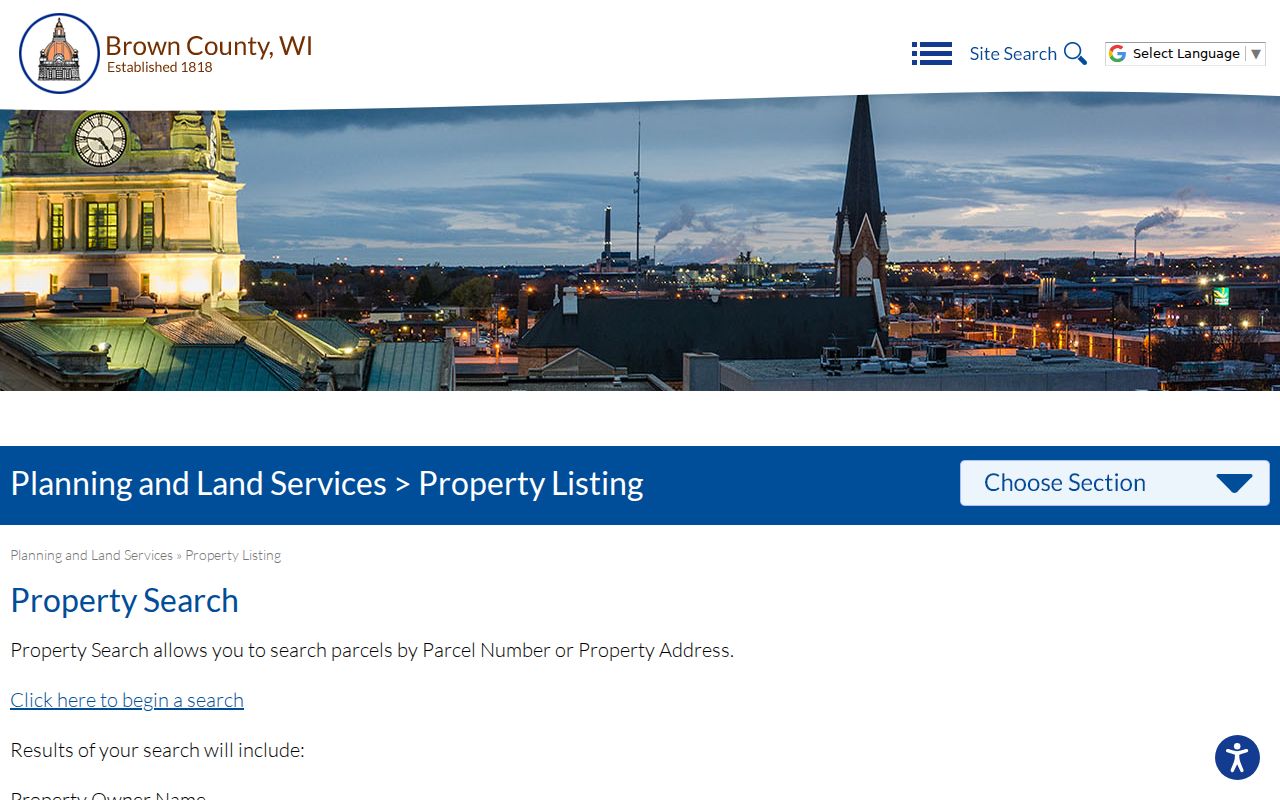
The county's Property Search page explains each parcel result and where its roll data comes from.
Find a Brown County Tax Bill
Begin with a parcel number or situs address. Follow the tax-record link shown on the county result. The right payment route depends on the municipality and the time of year. Read the bill for the current balance, installment terms, and payment instructions, then contact the Treasurer or local treasurer if a receipt or an older bill is missing.
- Find the parcel in Brown County Property Search and copy its municipality and parcel number.
- Open the tax link for the correct municipality and collection period.
- Compare the bill’s land, improvement, and total figures with the local assessment record.
- Check payment status and any delinquency with the responsible treasurer.
- Assessed value
- The value placed on the local tax roll.
- Levy and rate
- Local taxing amounts used to calculate a bill.
- Lottery/gaming credit
- A Wisconsin property-tax credit with forms linked by the Treasurer.
- Delinquency
- An unpaid tax balance; it is not proof a tax deed issued.
Brown County Installments and Bill Dates
Brown County property tax bills are mailed around December 10, the Treasurer reports. The first installment is due January 31. The second is due July 31. Where you pay depends on the municipality. The time of year matters too, since a town or city may follow a different collection route than another municipality. Keep the parcel number with any receipt. Keep the tax year with payment confirmations too. If a bill never arrives, contact the Treasurer or local treasurer rather than assuming no balance is owed. The Treasurer's page also links online payment, tax-rate information, and tax-bill address changes. See the Treasurer's current information page for collection links and office guidance.
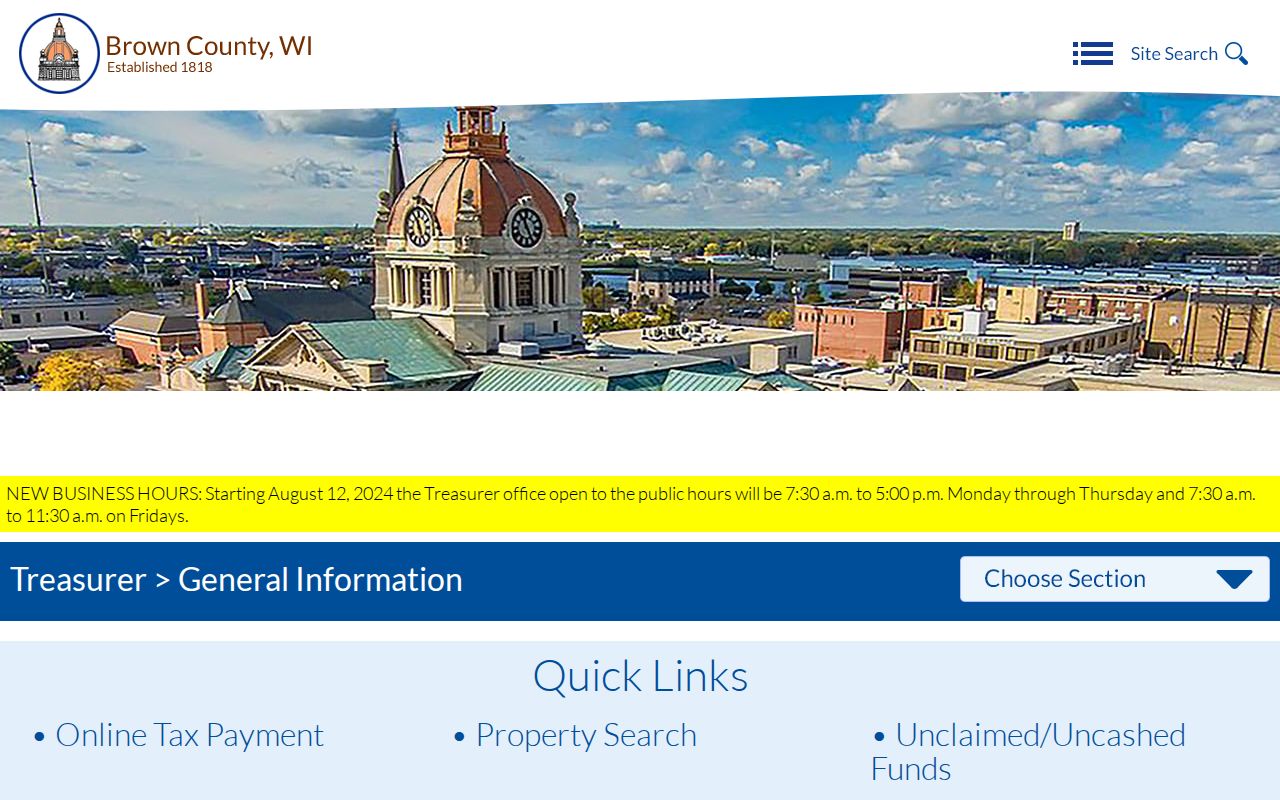
This is a general office page. For a specific account, the parcel bill remains the source for the correct payment route.
Brown County Assessment Search Fields
Match the search field to the clue in hand. The general Land Records Search splits its fields by parcel number, alternate parcel number, address pieces, owner name, plat description, public-land-survey entries, and municipality. Not every detail lives at the county level. Brown County warns that current-year values need local verification. So do not assume the county roll carries every local property-record-card detail for each municipality.
| Portal field | Control | Tax-record use |
|---|---|---|
| Parcel # or Alt. Parcel # | Text | Join a bill to the parcel record |
| House # and Street Name | Text with street dropdowns | Start from the situs address |
| Municipality | Dropdown | Choose the correct local tax jurisdiction |
| Section / Township / Range | Dropdowns | Find rural parcels described by survey location |
| Current / Historical Properties | Checkboxes | Check an older or replaced parcel number |
The live form sets the exact options. A tax account tied to a different municipality, or a retired parcel number, may call for the historical property selection or a direct question to the office.
Brown County Values and DOR Ratios
DOR publishes assessment ratios and equalized values. Wisconsin DOR releases these measures by municipality. They explain assessment levels and let you compare a local roll with statewide standards. Neither one is a home's market value. The assessed figure comes from the local tax roll. Equalized value works at the municipality level. The state assessment manual explains maintenance and revaluation concepts. DOR's 2026 notice set a June 8 municipal filing deadline. It listed preliminary values for July 31. Final equalized values were scheduled for August 14. Because that notice described a schedule, check the live DOR release for final status before using the year's figures in a tax analysis. For the distinction between assessed value, a sale price, and a market appraisal, see the separate Brown County property value explanation.
Brown County Open Book and Review
Start with the local assessor. The municipality named on the parcel determines which office that is. Compare the land and improvement fields against the assessment notice, the parcel description, and any available documents. Ask when Open Book takes place. Ask what evidence the assessor needs. Also ask how to request a Board of Review hearing. Open Book dates vary across Brown County, so do not rely on a statewide calendar. A strong review file keeps the parcel number, assessment year, notice, photos or survey material, and a clear description of the disputed field. A recent deed price may be relevant evidence. It is not automatically equal to the assessment. Confirm the process and submission requirements directly with the municipality.
Brown County Delinquency and Tax Action
Delinquent property tax records in Brown County sit with the Treasurer, an office that also handles foreclosure administration. An unpaid balance can trigger county action. Delinquency alone is not a completed tax deed. For a parcel carrying a notice, pull the Treasurer account, the recorded instruments, and any related public Circuit Court case. Confirm results in the recorded document and court file.
Sheriff sales follow a published Brown County schedule. Sales land on the second and fourth Wednesday of each month at 10 a.m. A Circuit Court confirmation hearing follows the sale. Check a hearing date through CCAP or the Clerk of Courts, and review the final order and any later conveyance before treating the property as sold.
Brown County Tax Mail and Credits
The mailing address on a Brown County parcel record may not match the situs. A bill can go to another residence. Owners also use trustees, agents, or named tax-bill recipients. The Treasurer's page posts address-change instructions along with lottery and gaming credit forms. Use the current form and follow the municipality's directions. Each program controls its own eligibility and filing rules.
A misdirected bill is fixable. Keep the parcel number and tax year ready. Contact the Treasurer or the municipal treasurer. The fix never changes the boundary or municipality of the parcel itself.
Review a Brown County Assessment
Assessment questions start with the municipality and the year. Brown County assembles its parcel information from Property Listing, the Treasurer, and municipal assessors. The county still defers to the local assessor on current-year assessments. That office runs the Open Book period. It can also explain the evidence rules and Board of Review procedure for the parcel's municipality. No single countywide filing date covers every local appeal.
Local schedule. Brown County has municipal assessment administration. Confirm the current Open Book and Board of Review dates with the local assessor listed for the parcel before filing evidence or requesting a review.